72-Hour Unlock Quiz (Heyflow) — a Call booking funnel teardown
ProductSaaS
TypeCall booking
CategoryMarketing software
How Heyflow’s 72-hour unlock funnel works
Heyflow sells software for building conversion funnels, and its own highest-intent offer
is built as a Heyflow flow on Heyflow’s own hosted domain — the vendor’s product is the
artifact under the microscope.
The shape is an application, but it never feels like one. The visitor experiences a
free “1-minute eligibility check”; Heyflow runs a hard gate at $100,000 of monthly ad
spend. The quiz cannot tell you you’re wrong — aim low and you get “We have gone even
further before!”, aim high and you get “Ambitious goal, but we’ve done it before!”. No
answer produces friction, so the only screen that actually filters is the spend question,
and it arrives fourth, once momentum is established.
Objection handling is withheld until after commitment. The competitor comparison
table isn’t on the landing page, where it would invite comparison shopping. It appears
mid-quiz, four answers deep, when leaving costs something. Then the payoff is arithmetic
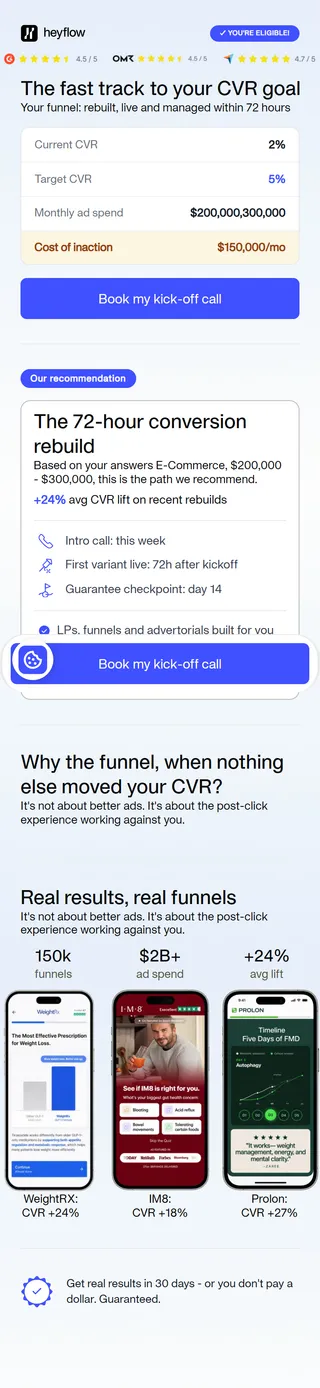
performed on the visitor’s own answers: after a staged “Calculating your personalized CVR
forecast…” delay, the recap multiplies the gap between their current and target
conversion rates into a “Cost of inaction: $150,000/mo” in warning amber, directly
above the booking button. A claim Heyflow makes about itself is arguable; a number
derived from figures the visitor typed is harder to wave away.
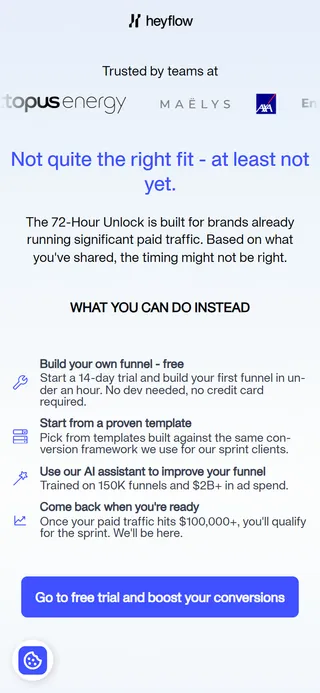
The rejection branch is the best-built screen in the funnel. Failing the spend gate
produces a downsell, not a dead end: a 14-day free trial with no card, and a stated
threshold for coming back. Its CTA leaves for the same signup URL that five other ads in
this campaign set point at directly — so the gate that rejects a lead for the service is
the acquisition channel for the product. Even a visitor who does book is offered the
trial on the confirmation screen. Nobody is allowed to leave without a next action.
Funnel canvas — drag to pan, scroll or use the buttons to zoom. Each node links to that step's page.
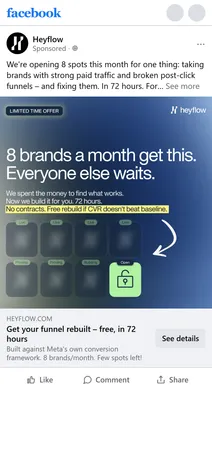
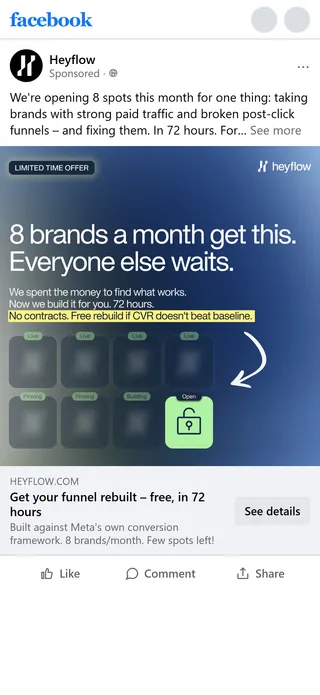
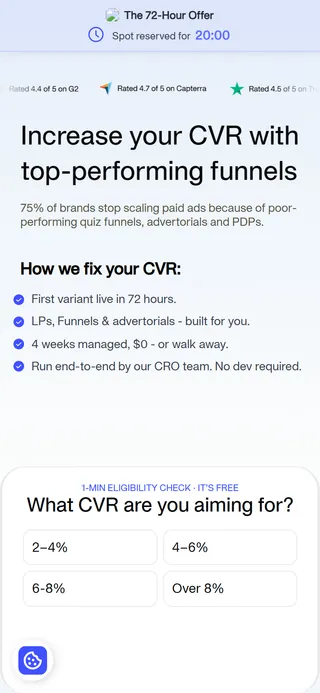
The ad draws an 8-slot grid with exactly one green "Open" tile, so the scarcity is counted rather than claimed. The flow then restates it as a personal "Spot reserved for 20:00" countdown the moment it loads.
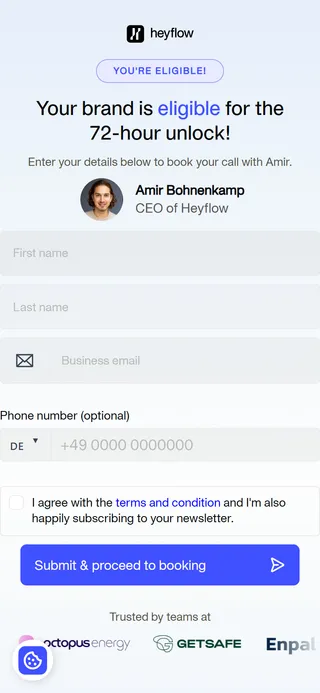
Aim low and it answers "We have gone even further before!", aim high and it says "Ambitious goal, but we've done it before!". Only the ad spend question, with its $100,000 floor, actually filters.
After a staged "Calculating your personalized CVR forecast" delay, the recap multiplies the visitor's current and target conversion rates into "Cost of inaction: $150,000/mo". It sits directly above the booking button.
Under $100,000 of monthly spend there is no dead end. The visitor gets a 14-day free trial offer and the line "Once your paid traffic hits $100,000+, you'll qualify".
On a computer this funnel opens as a canvas: every page at full length, side by side, with the arrows between them and the moves that make it work. A phone screen can't hold it, so here it's a list.
The ad draws an 8-slot grid with exactly one green "Open" tile, so the scarcity is counted rather than claimed. The flow then restates it as a personal "Spot reserved for 20:00" countdown the moment it loads.
Aim low and it answers "We have gone even further before!", aim high and it says "Ambitious goal, but we've done it before!". Only the ad spend question, with its $100,000 floor, actually filters.
After a staged "Calculating your personalized CVR forecast" delay, the recap multiplies the visitor's current and target conversion rates into "Cost of inaction: $150,000/mo". It sits directly above the booking button.
Under $100,000 of monthly spend there is no dead end. The visitor gets a 14-day free trial offer and the line "Once your paid traffic hits $100,000+, you'll qualify".